How to Trade the Economic Calendar Without Overreacting to Every Headline

The headline hits. Spreads widen. Your chart looks like it belongs to a different symbol.
You click because "something is happening." Two minutes later you are stopped out on noise, holding a thesis that was never written down, wondering why economic calendar trading feels like gambling with a Bloomberg tab open.
Most traders fail macro events for the same reason they fail breakouts: no plan for before, during, and after the print. They react to color (green beat, red miss) instead of to structure on a chart they captured when thinking was still possible.
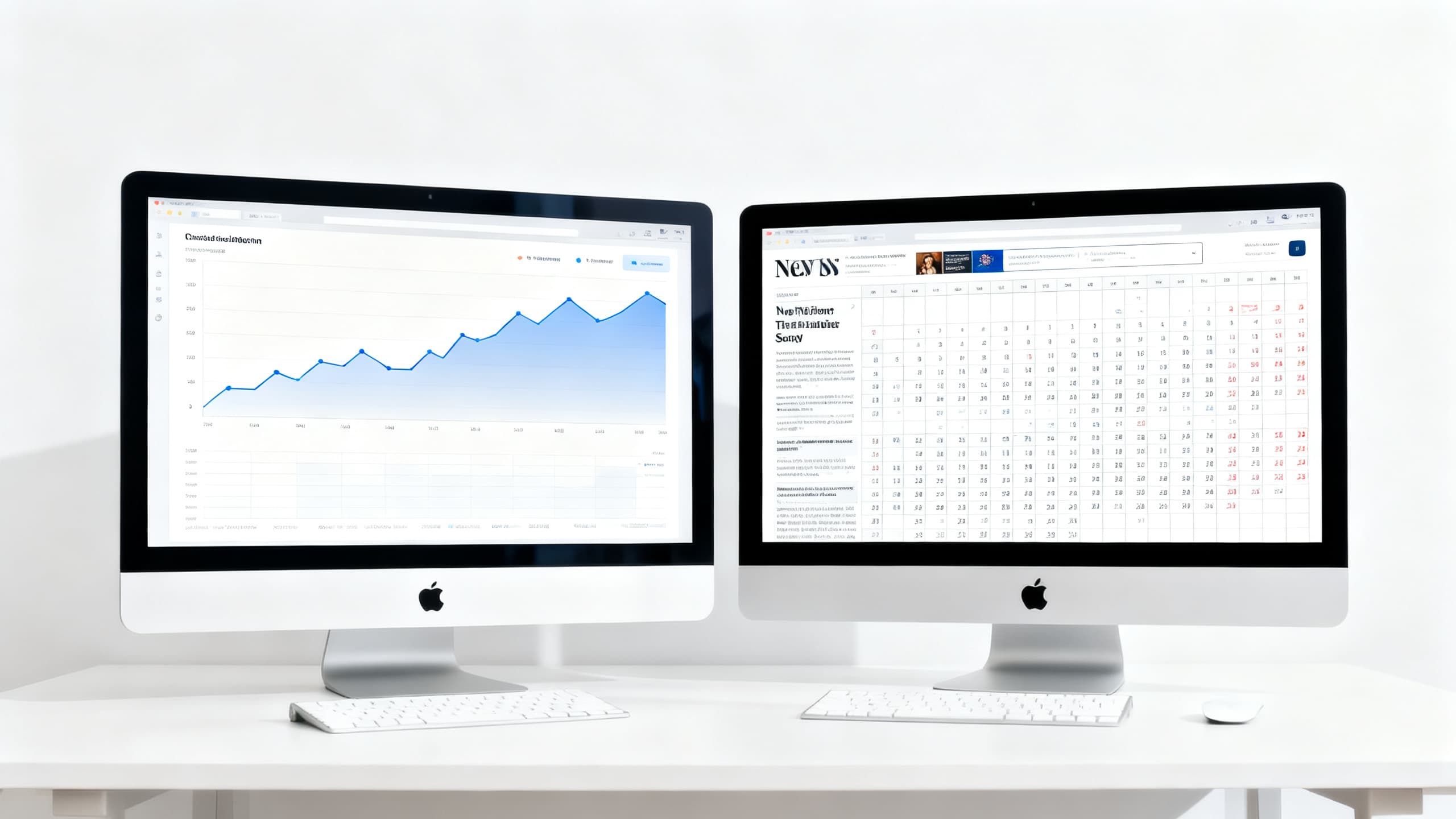
This guide bridges chart traders and fundamental traders: tier the calendar, screenshot your levels, choose widen-or-stand-down rules, and compare post-news structure without overreacting to every headline.
Who this is for
This fits you if:
- You trade forex, indices, gold, or rates-sensitive equities around CPI, NFP, FOMC, or central bank weeks.
- You use TradingView or broker charts but ignore the calendar until price spikes.
- You either sit out everything (FOMO) or trade everything (overreacting).
- You want fundamental analysis tied to execution, not Twitter consensus.
If you hold multi-week swings with no intraday entries, skim the tier system and stand-down rules. If you day trade around releases, read the full screenshot workflow.
Why the calendar breaks chart traders
Charts show what price did. The calendar shows when liquidity and narrative can change fast.
Three predictable failure modes:
Headline chasing: entering on the first spike because movement equals opportunity. Movement often equals stop runs and spread traps.
Pre-news compression blindness: tight range before CPI looks like "coiling." Sometimes it is dealers hedging. Your breakout long becomes exit liquidity.
Post-news story retrofit: after the move, you redraw lines to fit the print. That is not analysis. That is commentary.
Economic calendar trading works when fundamentals set context and risk, and charts set timing and invalidation. Neither alone is enough for most discretionary traders.
Screenshots help because they freeze pre-news structure before adrenaline edits memory. Same reason the screenshot analysis pillar starts with a frozen chart, not a live tick feed.
Tier system: not all events deserve your size
Treat the calendar like a risk dial, not a schedule of mandatory trades.
Tier 1: Stand down or plan-only (high impact)
These move cross-asset pricing and liquidity. Default rule: no new discretionary entries from five minutes before through 15 to 30 minutes after unless you completed a written news plan.
Examples:
- US CPI (headline and core)
- US NFP and unemployment rate
- FOMC rate decision and press conference window
- ECB, BoE, BoJ policy decisions
- GDP (advance/release that shifts rate expectations)
Plan-only mode means: screenshots, levels, scenarios, size cap at 0.5R, or sim. Not "I will feel the room."
Tier 2: Reduce size and widen stops (medium impact)
These matter if you trade the affected market. Size at 50 to 75% normal. Stops beyond the pre-event range, not inside it.
Examples:
- PPI, PCE, retail sales
- ISM manufacturing/services
- Jobless claims (when trend-shifting)
- Major earnings for single stocks you day trade
- PMIs and consumer confidence when trend breaks are live
Tier 3: Awareness only (low impact for your symbol)
Note them. Do not restructure your week.
Examples:
- Housing starts for a EURUSD scalper (unless housing is the day's narrative)
- Secondary revisions
- Speeches without policy vote proximity
Build a personal filter: If the event can change rate path expectations for my traded market, Tier 1 or 2. If unsure, upgrade one tier. Cheap insurance.
| Tier | Default action | Size | Stop treatment |
|---|---|---|---|
| 1 | Stand down or scripted plan | 0 to 0.5R | Outside pre-event range |
| 2 | Trade A+ only | 0.5 to 0.75R | Widen vs normal |
| 3 | Normal process | 1R max normal | Standard structure rules |
Pre-news screenshot workflow
Run this 30 to 60 minutes before a Tier 1 or Tier 2 event affecting your symbol. Same steps for forex news or index futures.
Step 1: Label the event context
Write four lines:
Symbol and timeframe:
Event and time (with timezone):
Tier (1 / 2 / 3):
My bias going in (long / short / neutral / stand down):
If bias is "whatever happens," you are not ready to trade the event.
Step 2: Capture pre-news charts
Save two screenshots:
Context (1H or 4H): range of the last 24 to 48 hours, obvious swing high/low, trend direction.
Execution (5m or 15m): pre-event compression, nearest liquidity pools, where stops likely cluster.
File names example: 2026-01-28_EURUSD_1H_preCPI.jpg and 2026-01-28_EURUSD_5m_preCPI.jpg.
Mark lightly:
- Range high/low of the pre-event box
- Invalidation for bullish and bearish scenarios (both sides, even if you lean one way)
- No-trade zone inside the middle third of the range (optional but useful on Tier 1)
This mirrors the level map in our pre-market trade plan checklist. Macro just adds a clock.
Step 3: Write if-then scenarios (both directions)
Every event plan needs at least two branches.
Template:
If break and hold above [range high] with [confirmation rule],
  then [entry type] toward [target], stop below [level].

If fake break above and close back inside range,
  then fade toward [range mid or low], stop above [failed high].

If no resolution in [30 min], then no trade.
Confirmation rules must be objective: close above on 5m, retest hold, volume not required if you cannot measure it honestly.
Stand down branch (Tier 1 default):
If I have no pre-written scenario match, I do nothing.
If spread doubles my normal, I do nothing.
If first spike is > X pips/points without retest, I do nothing.
Define X before the print, not after.
Step 4: Set risk budget for the event window
Write max loss for the event session: often 1R total on Tier 1 planned trades, 0R if stand-down mode.
Note calendar overlap. CPI day plus Fed speaker plus earnings on a holding you trade equals Tier 1 even if each item alone is Tier 2.
During the release: execution rules
If you are not in a planned trade before the print, default is wait. The first candle is marketing, not structure.
Do not:
- Market order on the spike
- Remove stops "until it settles"
- Add to a loser because "fundamentals support it"
- Switch symbols because another pair moved more
Do:
- Wait for your confirmation rule
- Check spread and slippage on your broker
- Start cooldown if stopped once (20+ minutes)
For FOMC and press conferences, treat the statement drop and Q&A as two waves. Many traders plan the first wave, get stopped, revenge trade the second. Cap at one attempt per wave or stand down entirely.
For NFP, the first minute often whipsaws through the range. Fading the first move without a failed-break setup is a coin flip dressed as macro skill.
For CPI, core vs headline divergence can reverse the initial move 10 to 20 minutes later. If your edge is 5m structure, Tier 1 stand-down is valid more often than not.
Post-news screenshot workflow
15 to 30 minutes after a Tier 1 print (sooner for Tier 2 if range breaks cleanly), capture post charts at the same timeframes as pre.
Compare pre vs post
Open images side by side and answer:
- Did price accept outside the pre-event range or reject back inside?
- Is structure trend continuation or range re-establishment?
- Where is the new decision zone (retest level, failed break, fresh swing)?
- Did my pre-written scenario branch trigger? If no, what branch is live now?
Save post files: 2026-01-28_EURUSD_5m_postCPI_20m.jpg.
Re-plan, do not retrofit
If the live branch was not on your card, you are not allowed to call it "close enough." Write a new card from post structure or stop.
This is where chart-first traders often improve fastest: fundamentals tell you something changed; post-news screenshots tell you what price did about it.
Upload post-news screenshots through the same structured workflow in how to analyze a trading chart screenshot with AI. Compare your invalidation to the generated plan. Divergence means smaller size or wait.
Widen stops or stand down: decision tree
Use this tree when volatility expands.
Tier 1 event within 30 minutes?
  Yes → Stand down OR 0.5R scripted plan only
  No → continue

Already in open trade from before event?
  Yes → Widen stop to pre-defined news stop OR reduce size OR flat before release
  No → continue

Pre-event range still intact after first spike?
  Yes → Fade setups need failed break proof; breakout setups need hold + retest
  No → Trade retest of broken range edge; stops outside new structure

Spread/slippage > 2x normal?
  Yes → Stand down
  No → execute plan if confirmation met

Two losses in event window?
  Yes → Session done
  No → max one more planned attempt
Widen stops does not mean "infinite." It means place stops beyond the pre-event range or beyond the post-spike swing, not inside the noise band where market makers hunt.
Stand down is correct when confirmation rules never met, when you missed the move and feel FOMO, or when emotional urge exceeds plan clarity. Missing CPI is not a sin. Revenge trading CPI is.
For sizing math when stops widen, revisit position size and 1% risk from the chart. Wider stop with same dollar risk means smaller contracts. Most overreactors forget this and double emotional size instead.
Bridging fundamentals and chart structure
You do not need a PhD in macro. You need three fundamental questions answered before risk:
- What is the market pricing in? (rates higher for longer, cuts soon, soft landing, etc.)
- What surprise direction hurts crowded positioning? (hot CPI vs cool CPI, strong NFP vs weak)
- Does my chart location offer asymmetric reward if the surprise hits, or am I mid-range?
Fundamental analysis sets which side is dangerous to fade without proof. Charts set where proof lives (break, retest, failure).
Example prose workflow (no fake prices):
- Before CPI, rates-sensitive pair compresses near range high into event.
- Hot CPI scenario: break-and-hold above range favors continuation toward next liquidity.
- Cool CPI scenario: failed break above range favors fade back toward range mid.
- No scenario: close inside range for 30 minutes, go to cash.
Chart traders gain discipline from the calendar tier system. Macro traders gain execution from screenshot compare loops. Economic calendar trading improves when both sides write the same if-then card.
How Bullsights macro context fits (neutral use)
Structured tools should reduce ambiguity, not replace the tier rules above.
When you upload a pre or post-news screenshot, Bullsights returns entries, stops, targets, scenarios, and macro context from specialized subagents. Useful pattern:
- Complete your manual if-then card and tier decision first.
- Upload screenshot for a second structural read.
- Compare macro context to today's event tier. If narrative and structure conflict, default to stand down or smaller size.
- Log output next to your journal entry for Sunday review.
Bullsights does not predict CPI prints. It documents what the chart shows and flags scenario risk so you stop trading one-sided stories into two-sided events.
Pair event weeks with the trading journal weekly review. Tag entries CPI, NFP, FOMC and review process separately from quiet days. You will often find macro days are red because of rule breaks, not because the market was "untradeable."
Common mistakes
Trading the expectation, not the reaction. Your thesis about what should happen is not a setup.
One-sided plans on Tier 1. Always write failure branches.
Shrinking stops when spread widens. You pay more to be wrong; give structure room or skip.
Watching five pairs during NFP. Pick one or stand down.
Ignoring the calendar because "price tells all." Price tells all after liquidity returns. The first minute is often lieutenant noise.
Using fundamentals to justify revenge. A miss on NFP does not entitle a double-size re-entry.
Quick checklist
Weekly calendar prep (Sunday or Monday):
- Tier 1 and Tier 2 events flagged for traded symbols
- Conflicts noted (CPI + FOMC same week, etc.)
- Default stand-down days marked on calendar
Pre-news (Tier 1 or 2):
- Event tier confirmed
- Context + execution screenshots saved
- Range and invalidation marked
- Long and short if-then cards written
- Event session R budget set
- Stand-down triggers defined (spread, no confirmation)
During release:
- No impulsive first-spike entries
- Confirmation rule met before click
- Cooldown honored after stop
Post-news:
- Post screenshots saved (same timeframes as pre)
- Pre vs post compare completed
- New plan written or session ended
- Journal tagged with event name
FAQ
Should I close open trades before CPI or FOMC?
Three valid choices: flat before release, reduce size with widened stop to pre-defined news level, or hold swing with stop beyond event noise. Pick one rule per account and stick to it. Mixing rules per trade creates revenge-shaped decisions.
How do forex news traders differ from index futures traders on the calendar?
Forex spreads and slippage spike around Tier 1 USD prints. Index futures may move more smoothly but faster in points. Tier system is the same; execution confirmation and stand-down windows may need longer on your broker. Test in sim once per quarter.
Is it better to fade the initial move or trade the breakout?
Neither universally. Tier 1 requires a written branch for each. Fading the first spike without a failed break is gambling. Breakout trading without hold-and-retest confirmation is chasing. Let pre-news range structure pick the branch.
Can I automate economic calendar filters?
Use alerts for time windows and level breaks. Do not automate entries on Tier 1 until you have 20+ journaled event trades with green process. Automation scales discipline or damage equally.
Bottom line
Economic calendar trading stops being a headline reaction when you tier events, screenshot pre-news structure, script if-then branches, and compare post-news charts before risking full size.
CPI, NFP, and FOMC are not invitations to click faster. They are deadlines for plans you write while spreads are still normal.
Stand down more than you think. Widen stops when you trade. Let confirmation arrive before size returns to normal.
When you want structured entries, stops, targets, scenarios, and macro context from the same screenshots you use for event planning, try Bullsights. Calendar for timing. Charts for proof. AI to document both without overtrading the noise.